Our specialty
Corporate catch-up and clean-up, from one year behind to ten.
Unfiled T2 returns, GST/HST that stopped, books that were never reconciled, letters from CRA you haven’t opened. We rebuild the records, file everything that’s due, and deal with CRA for you once you’ve authorized us.
What a catch-up covers
Every catch-up is scoped to what’s actually outstanding. Depending on your file, that includes:
- Bookkeeping rebuilt for every missing year
- Every bank and credit card account reconciled
- The shareholder loan account untangled
- Year-end financial statements
- T2 corporate returns, oldest year first
- Missed GST/HST returns for every period
- Payroll remittances, T4 and T4A slips
- CRA correspondence, where we’re authorized
- CRA’s estimated assessments replaced with real returns
- Penalty relief requests, where you qualify
Common CRA situations
Already heard from CRA?
Plain-English guides to the letters and questions that come up most, and what to do about each.
How a catch-up works
Four stages. Nothing starts without your sign-off.
-
Talk it through
On your free assessment you tell us what’s outstanding — T2s, GST/HST, payroll, bookkeeping — and what CRA has sent, and we explain how we’d get you caught up.
-
Confirm the scope
You receive a written proposal covering the scope, pricing, terms, the records we’ll need, and a timeline. Work begins once you approve it, with a 50% deposit.
-
Complete the catch-up
The books are rebuilt from bank and card statements, oldest year first, and every outstanding return is prepared and filed. If the scope changes materially, we talk before going further.
-
Stay current
Once you’re caught up, monthly bookkeeping keeps you there. It’s month to month, and you can cancel with 30 days’ notice.
 Catch-up proposal
Prepared for: Your Corporation Ltd.
Outstanding
- T2 corporate returns
- FY 2021 – FY 2025
- GST/HST returns
- 2022 Q1 – 2026 Q2
- Bookkeeping
- Jan 2021 – present
- CRA correspondence
- Demand to file, FY 2023
Records we’ll need
- Bank & credit card statements
- 2021 – present
- Last filed corporate return
- FY 2020
The cost of waiting
Filing late isn’t a flat fine. It’s a percentage, and it grows.
CRA’s late-filing penalty on a corporate return is 5% of the unpaid tax, plus 1% for each full month late, up to twelve months. If CRA has sent a demand to file and a late-filing penalty also applied in one of the three previous years, it rises to 10% plus 2% a month, up to twenty months. Interest is charged on top. Move the sliders to see roughly where a corporation stands.
| Year | Months late | Penalty rate | Penalty |
|---|---|---|---|
| FY 2025 | 4 | 9% | $2,250 |
| FY 2024 | 16 | 17% | $4,250 |
| FY 2023 | 28 | 17% | $4,250 |
Estimated late-filing penalties
$10,750
Plus estimated interest
$10,982
An estimate to start a conversation, not a calculation of your account. It assumes a
December 31 year-end, the full year’s tax still unpaid, and every return filed and paid today,
October 31, 2026. Penalties follow ITA 162(1), or 162(2) when the
box is ticked, and stop growing after 12 months (20 for the higher rate). Interest uses CRA’s prescribed
rate for overdue tax in each quarter (7% throughout 2026), compounded
daily. It runs on the tax from three months after year-end (the balance-due date for most small
Canadian-controlled private corporations) and on the penalties from the filing due date. Instalment interest isn’t included.
GST/HST has its own penalty under ETA 280.1. A year with no tax owing carries no late-filing
penalty, but the return is still required, and an unfiled year stays open to reassessment.
A typical catch-up year$2,000
Catch-ups are priced per year outstanding: typically $2,000 a year for an active corporation, and from $750 for a year with no activity. Transaction volume, the number of accounts and the condition of your records move it from there. You’ll have the price in writing before any work begins.
How pricing worksYour free assessment
What happens in 15 minutes
- You tell us what’s outstanding: which years, which filings, and any letters from CRA
- We explain how we’d get you caught up, in what order, and which records we’d need
- We show you how we’d keep you caught up once you’re current
- Afterwards, you receive a written proposal with the scope, price and timeline
It’s a conversation for clarity. Nothing starts on the call, and nothing starts afterwards without your written approval.
Book your Free Catch-Up AssessmentBring what you have. You don’t need everything.
- What you know is outstanding: roughly which years and filings are behind
- Any CRA letters, notices or deadlines
- Your last filed corporate tax return, if you have it
- Whatever bank and credit card statements you can get to
- Access to your bookkeeping software, if you use one
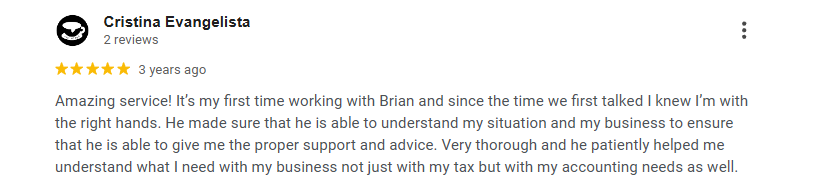
Amazing service! It’s my first time working with Brian and since the time we first talked I knew I’m with the right hands. He made sure that he is able to understand my situation and my business to ensure that he is able to give me the proper support and advice. Very thorough and he patiently helped me understand what I need with my business not just with my tax but with my accounting needs as well.
Cristina Evangelista

Quick turnaround time. Was very helpful with all my questions and concerns. Prices were reasonable and felt like I had personalized service that I haven’t gotten before from any accounting firm. Will definitely be using them for all my accounting needs. Would recommend them to everyone.
Anthony Reyes

Great Experience! Helped me catch up on my business taxes, also with bookkeeping and even helped me out with my tax returns.
John Yadao

Initially helped my organize my bookkeeping and continues to help me keep my accounting needs in order!
Kris F
Catch-up questions
The hard questions, answered plainly.
How far behind is too far behind?
Being ten years behind is a bigger project than being two years behind, but it’s the same project. The returns still have to be filed, and filing them is what keeps the situation from getting worse.
Am I in criminal trouble for not filing?
In practice, filing late is dealt with through penalties and interest. Prosecution is generally reserved for deliberate tax evasion and for ignoring a formal demand to file, which is an offence in itself. Coming forward before CRA contacts you earns the most relief; after CRA makes contact, less relief is available.
CRA already assessed a year we never filed. Is that final?
Not necessarily, but don’t wait. That’s a notional (or arbitrary) assessment under s.152(7): CRA’s estimate in the absence of a return, and usually well above the real figure because it rarely reflects your expenses. Filing the actual return, with support, is how it usually gets replaced. The time limits run from the date on the notice: 90 days to object, and CRA’s normal reassessment period of three years for a CCPC (four for other corporations). After that, it can be very hard to change.
We don’t have receipts for most of it.
That’s common, and usually workable. Bank and credit card statements plus supplier records reconstruct most of a year. You’ll get an honest view of which expenses can be supported and which can’t.
Will the penalties be waived?
Sometimes, and it’s worth pursuing. Under the Voluntary Disclosures Program, as changed on October 1, 2025, an application made before CRA contacts you can relieve all of the penalties and 75% of the interest. One made after CRA has raised the issue can still relieve up to 100% of the penalties, but only 25% of the interest. The program needs complete disclosure and payment (or a payment arrangement), and it isn’t available once an audit or investigation has started. Taxpayer relief is a separate route for circumstances like serious illness or financial hardship. Neither is automatic. See our VDP guide.
What about my personal tax returns?
When the corporate years are unfiled, the owner’s personal years often are too, and they’re connected through salary, dividends and the shareholder loan. Raise it on your assessment so both sides can be planned together.
Free call · 15 minutes · No obligation
See your path back to current before you commit to anything.
Book a free 15-minute call with Brian Catibog, our founder. Tell us what’s outstanding, and we’ll show you how we’d get you caught up and keep you there. The scope and price follow in writing.






 +2
A growing team, and you can see exactly who’s on it. Meet the team